Third Sector’s first annual Government Transformation Agenda focuses on The Three P’s of Systems Change—Practices, People, and Perspectives— providing a framework for governments and philanthropy to build public systems that are more responsive and outcomes-driven, ultimately strengthening our democracy.
Contents
Open
Close
Practices: Unlock Possibilities In Your Community
Create space for new practices to emerge. Whether through cohort learning spaces or pilot projects, systems transformations emerge from exploration, innovation, and opportunity to practice new ways of working.
Pair learning with real work. Shifts take hold when teams apply new tools to live projects, confront structural barriers directly, and advance outcomes tied to their actual roles.
Engage all voices to improve outcomes. Collaboration across diverse expertise and lived experience leads to stronger program design and practices that respond to real community needs.
Start Today
Set aside structured time for staff and partners to test and reflect on how work gets done, not just what gets delivered.
Identify one current implementation challenge where your team can try an outcomes-focused approach.
Do in the Next Six Months
Create formal and informal spaces for cross-agency learning, problem-solving, and experimentation that include community members and those directly impacted by the system.
Use a pilot, cohort, or learning forum to collaborate with those directly impacted to redesign one workflow, referral path, or contract to focus on outcomes.
Do Within the Next Year
Embed what works into standard practice through updated workflows, coordination structures, contracts, or accountability systems that reflect input from the communities served.
Measure whether those changes improved responsiveness, coordination, or support for the people your system serves by directly engaging consumers in feedback.
People: Catalyze Change Through Relationships
Share power to sustain change. Cross-sector partnerships andparticipatory governance strengthen systems by positioning constituents, providers, and community leaders as partners in decisionmaking rather than merely recipients of services.
Invest in trust as core infrastructure. Strong relationships across government, community organizations, and families take time to build, but they enable collaboration, adaptation, and long-term impact.
Design governance to match outcomes. Clear roles, shared accountability, and open communication create the conditions for new practices to take hold and endure beyond individual projects.
Start Today
Identify where constituents, providers, employers, or community leaders still sit outside decisionmaking and begin discussing how to bring them into real governance roles.
Name one area where weak relationships or unclear accountability are slowing progress on outcomes.
Do in the Next Six Months
Create formal structures for shared decisionmaking such as cabinets, councils, or cross-sector working groups.
Define clear roles, decision rights, and communication norms so collaboration can move from goodwill to practice.
Do Within the Next Year
Build these partnerships into how your system operates, not just how one initiative runs.
Track whether stronger relationships are improving coordination, responsiveness, and results for the people your system serves.
Perspectives: Confront Inequity in Systems
Perspective shifts come from lived experience. Hearts and minds change when leaders and practitioners work directly alongside the people most affected by the system.
Changing beliefs changes systems. To change systems, we have to change the stories and assumptions people hold about how systems work, what is possible, and even the communities they serve.
New perspectives fuel scale. Collaborative experiences turn practitioners into advocates, accelerating the spread of outcomes-based approaches beyond a single project.
Start Today
Identify one assumption shaping eligibility, service design, hiring, or policy that may be excluding people your system is supposed to serve. If none come to mind, ask the people you are serving!
Bring leaders and practitioners into closer contact with the people most affected by the system, especially those historically treated as peripheral or hard to serve. Give practitioners a real person, in addition to a purpose, to serve.
Do in the Next Six Months
Use disaggregated data and lived experience together to identify which populations your current system could serve better.
Test one evidence-based change that challenges default beliefs about who deserves support, what success should look like, or which pathways matter.
Do Within the Next Year
Redefine success in policy, funding, or implementation around outcomes like stability, mobility, persistence, and completion.
Scale the approaches that changed beliefs, improved access, and produced measurable improvements for your community members.
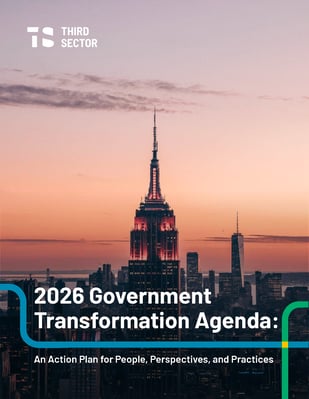
An Action Plan for People, Perspectives, and Practices
The 2026 Government Transformation Agenda outlines the Third Sector's approach to transforming government systems to be more outcomes-focused and responsive to community needs, grounded in approaches that tailor service-delivery methods to community members' voices and perspectives.







.png?width=275&height=79&name=TS_logo@2x%20(2).png "Third Sector Capital Partners Logo")
.png "Third Sector Capital Partners Logo")